How a Wi-Fi Router Works
Three sticks of plastic on a black box, each hiding six centimetres of copper — half a wavelength. It shouts with a tenth of a watt, listens for whispers a hundred billion times fainter, and lets exactly one device in the house talk at a time.
Step 01 of 09
It is whispering
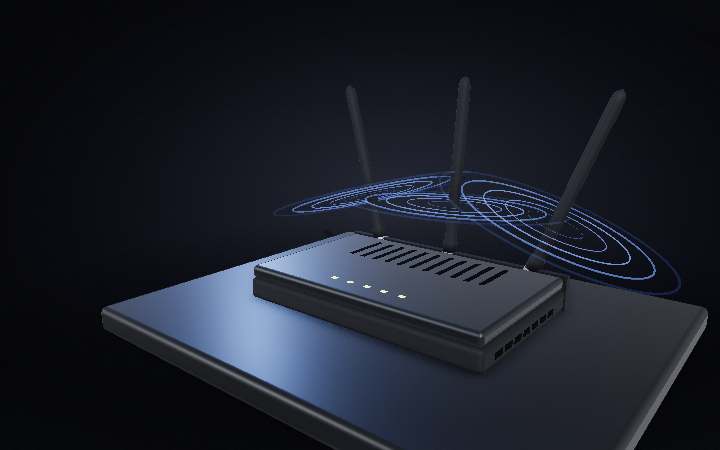
A black slab, five sockets and three sticks of plastic — and it never stops talking. But not loudly: a router transmits at about a tenth of a watt, a fraction of the bulb inside your fridge. What is remarkable is the other direction. It can hear a reply of one picowatt: a hundred billion times fainter than what it just sent. Almost all of the range you get is that ear, not the voice.
Step 02 of 09
Two machines sharing a lid
Lift the lid and one board is doing two unrelated jobs. Toward the back sits a gigabit switch chip: that corner is a very small network exchange, shovelling frames between the wired ports. Everything else is a radio. A processor under a finned heat sink runs the whole machine, a couple of memory chips hold what it is thinking, and each band gets its own soldered metal box.
Step 03 of 09
Why the radio lives in a tin box
Those little soldered cans are not styling. The receiver next to them has to pick out signals of a picowatt, and the digital side of the board is spitting switching noise a trillion times stronger — so the radio gets its own metal room, with holes stamped in the lid for heat but none big enough for the wavelengths it cares about. What leaves the room is tiny, so a power amplifier lifts it to about a tenth of a watt, and a hair-thin coaxial cable carries it to the antenna without letting a scrap of it leak on the way.
Step 04 of 09
Six centimetres of copper
The plastic stick is a raincoat. Inside it is a strip of circuit board with a thin line of copper up the middle, and the length of that line is the entire trick: at 2.4 gigahertz a radio wave is about 12 centimetres long, so the metal is cut to half of that — two arms of roughly three centimetres either side of the feed point. Current sloshes up one arm and down the other, 2.4 billion times a second, and the field it drags along cannot keep up and peels off into the room.
Step 05 of 09
A doughnut, not a ball
A dipole does not radiate evenly in every direction. It throws its signal out sideways, all the way round the horizon, and almost nothing along its own axis — the pattern is a doughnut with the antenna through the hole. Point an antenna straight up and you have aimed its one dead spot at the floor above. That is also why there are two elements on the strip: a long pair for 2.4 gigahertz and a pair half as long for 5, whose waves are only six centimetres from crest to crest. Shorter waves carry more data and bend around a doorway far worse — six to ten decibels of your house eats them.
Step 06 of 09
Everyone shares one wire
Here is the part nobody tells you: on a given channel, exactly one device may transmit at a time — the router included. Wi-Fi is half duplex, and the air is a single shared wire. So every device listens first, waits a fixed gap, then waits a further random moment so that two of them do not start together, and only then speaks; the receiver answers with an acknowledgement, and the floor is free again. A café network is not weak. It is a queue, and what you feel as lag is your turn coming round.
Step 07 of 09
Three antennas, one frequency
Since the queue is the bottleneck, everything modern is about finishing your turn faster. Three antennas send three different data streams on the very same frequency at the very same moment; they arrive smeared together, but each has bounced off the room differently, and the receiver — which also has several antennas — can untangle them. Then the router does something sharper still: it shifts the timing between its antennas by fractions of a wavelength so the waves reinforce in one direction and cancel elsewhere. The doughnut leans. Nothing moved.
Step 08 of 09
The half that gives it its name
Round the back is the machine the name actually refers to. One socket faces the internet; the other four face your house, and behind all five sit little transformers that pass the signal while keeping their voltages apart. The processor holds a table: every conversation your devices open gets a line in it, so when a reply arrives addressed to your single public address, the router knows which laptop in which room asked for it. Take that table away and the whole house would need its own address on the internet.
Step 09 of 09
Run it
A frame arrives on copper, crosses the switch, gets a line in the table, is handed to the radio, amplified to a tenth of a watt, pushed up a coaxial cable and shaken off six centimetres of metal as a wave — then the room answers in a whisper and the whole thing runs backwards. Several hundred times a second, all day, from a box you have never once thought about.