How Wireless Charging Works
No plug, no port — just two flat coils a few millimetres apart. How an oscillating magnetic field carries power across an air gap and into your phone, and why the two coils never actually touch.
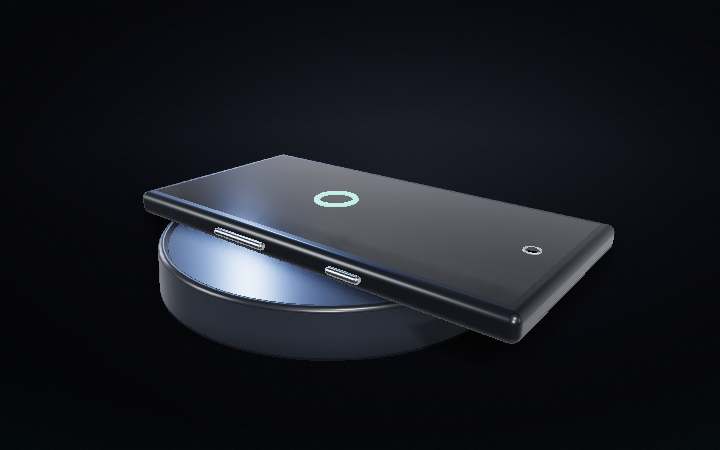
Step 01 of 06
Power with nothing plugged in
Set the phone down and it starts charging — no cable, no port, no contacts touching anywhere. Everything that carries the power lives sealed inside two smooth plastic shells: a flat coil in the pad, a matching coil in the phone, and a few millimetres of air in between. The trick is that electricity can cross that gap as a magnetic field, and turn back into electricity on the far side.
Step 02 of 06
Two coils, one gap
Strip the shells away and the whole machine is almost nothing: two flat spiral coils of fine copper wire, wound like clock springs and parked face to face a few millimetres apart. Behind each one sits a dark ferrite disc that gathers the magnetic field and keeps it from leaking into the surrounding metal. The coils never touch — the gap is the point.
Step 03 of 06
Alternating current, a moving field
The pad pushes alternating current through its coil — current that reverses direction more than a hundred thousand times a second. A moving current always drags a magnetic field along with it, so this coil becomes an electromagnet that flips north-south, north-south, at the same furious rate. The field loops up out of the coil, through its centre, and back around the outside.
Step 04 of 06
A field that makes current
Here is the payoff, and it is a law of physics: a magnetic field that changes through a loop of wire pushes a current around that loop — Faraday’s law of induction. The receiver coil sits right in the path of the pad’s flipping field, so that field drives its own alternating current in the phone’s coil. Power has crossed the gap with nothing but magnetism in between.
Step 05 of 06
From wobbling AC to a full battery
The current arriving in the phone is alternating, but a battery can only take steady DC. So a small rectifier chip flips every backward half-wave forward and smooths the result into a clean, one-way current — which is what finally trickles into the battery. About three-quarters of the energy the pad draws ends up here; the rest is lost as gentle warmth in the coils.
Step 06 of 06
Run it
A coil that makes a field, a field that makes a current, a chip that tames it into charge — three simple steps repeating a hundred thousand times a second, quietly, through a gap of empty air. No plug to wear out, no port to corrode: just two coils that agree to share a magnetic field.